
Moonwood: Hide & Seek Across Two Worlds
Video Game Design | 2-person team | AI adaptation of prior work
Moonwood is an asymmetric hide-and-seek game in which a fox searches for rabbits across two connected worlds. Players move between a seasonal woodland and the moon, choosing when to hide, follow a trace, spend energy, or disappear into the other world. The chase is shaped by an uneven balance of speed, agility, visibility, and information.
Originally developed with Wen Deng as a Unity prototype in 2019, Moonwood was revisited in 2026 as a browser-based game. The recreation became an ongoing exploration of game feel, environmental storytelling and AI-assisted prototyping, with iterative refinements to movement, cameras, camouflage, touch controls and online multiplayer.
Play Moonwood: https://go.osu.edu/moonwood
Game Overview
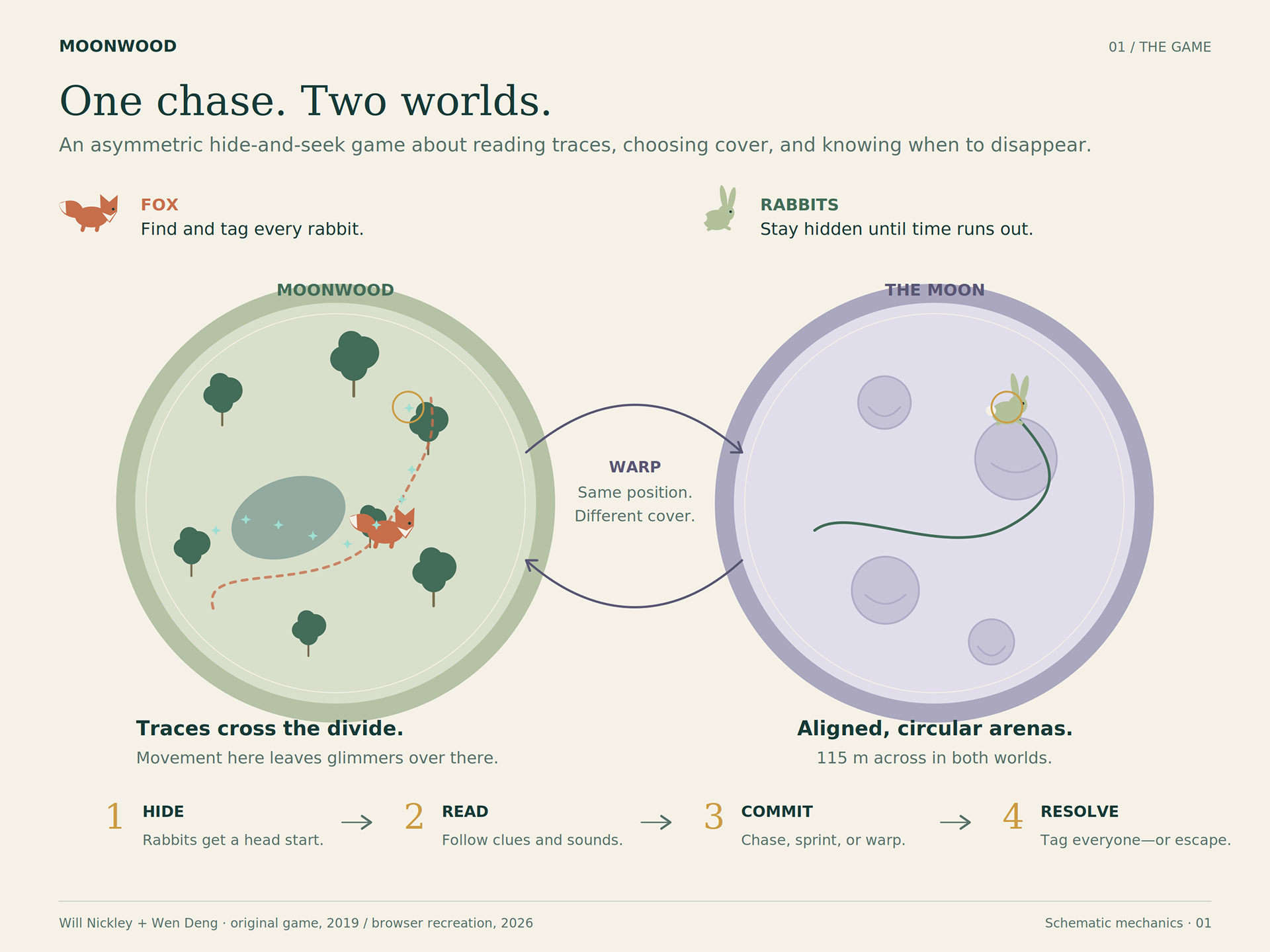
A schematic of two aligned circular arenas: a wooded pond landscape and a cratered moon. A fox pursues in Moonwood while a rabbit occupies the moon. Mint glimmers in Moonwood represent the rabbit's movement in the other world. Arrows show that warping changes worlds at the same position. A four-part sequence describes hiding, reading clues, committing to an action, and resolving the chase.
Game Mechanics
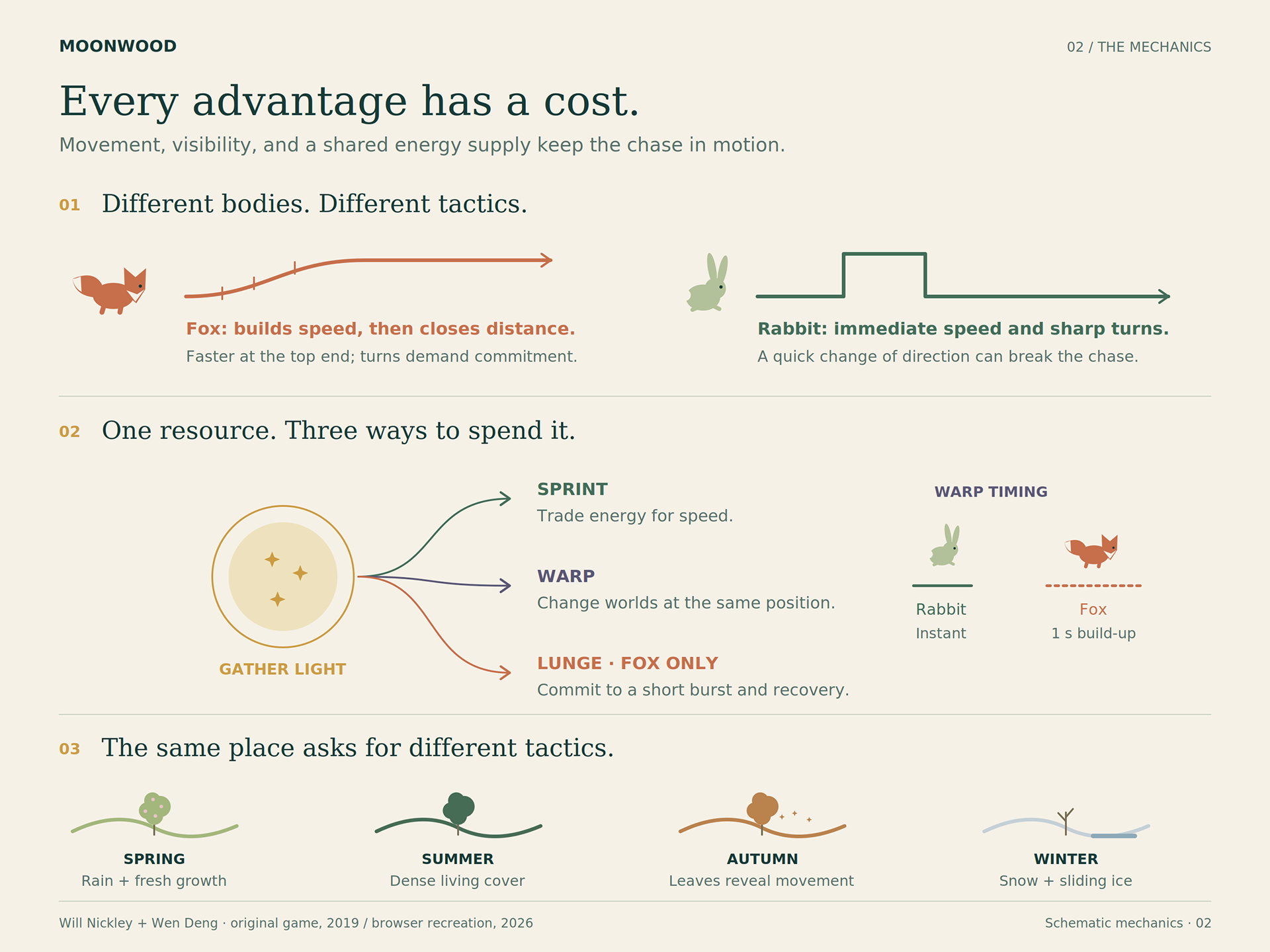
A comparison of the fox's accelerating pursuit with the rabbit's immediate movement and sharp turns. Collected light branches into sprinting, warping, and a fox-only lunge. A timing comparison distinguishes instant rabbit warps from the fox's one-second build-up. Four seasonal landscape vignettes show rain and fresh growth, dense summer cover, autumn leaves, and winter ice.
Post-game Recap
After each game, all players see a post-game recap that shows the paths each character took, how much time they spent hiding, how much energy they consumed and used, etc.
Game Design Decisions Log
1. Make the roles feel different through movement
The fox builds toward a higher top speed, while rabbits accelerate immediately and turn sharply. This gives each role a distinct way to play: the fox commits to a pursuit; the rabbits look for opportunities to change direction and disappear into cover.
2. Use two worlds to make escape a decision
Moonwood and the moon share a coordinate system, so warping changes the environment around a player without changing their position. An escape can become a prediction problem: where will an opponent reappear, and what cover will they find there?
Moonwood and the moon share a coordinate system, so warping changes the environment around a player without changing their position. An escape can become a prediction problem: where will an opponent reappear, and what cover will they find there?
3. Offer clues without giving away certainty
Movement leaves glimmers in the opposite world. Sneaking and stillness reduce their frequency, while the fox can pause to gather a general directional sense. These systems offer evidence to interpret rather than a continuously visible opponent marker.
Movement leaves glimmers in the opposite world. Sneaking and stillness reduce their frequency, while the fox can pause to gather a general directional sense. These systems offer evidence to interpret rather than a continuously visible opponent marker.
4. Give powerful actions a shared cost
Sprinting and warping draw from the same collected energy; the fox also spends it to lunge. Using energy to gain ground now can reduce the options available a moment later. Rabbits warp instantly, while the fox has a short build-up, giving escape and pursuit different rhythms.
Sprinting and warping draw from the same collected energy; the fox also spends it to lunge. Using energy to gain ground now can reduce the options available a moment later. Rabbits warp instantly, while the fox has a short build-up, giving escape and pursuit different rhythms.
5. Make the environment part of the rules
The four seasons change more than the palette. Dense summer growth provides cover, autumn leaves react to movement, spring introduces wet conditions, and winter replaces open water with sliding ice. The familiar map supports changing ways to move and hide.
The four seasons change more than the palette. Dense summer growth provides cover, autumn leaves react to movement, spring introduces wet conditions, and winter replaces open water with sliding ice. The familiar map supports changing ways to move and hide.
6. Shape the arena around a continuous chase
Both worlds use a 115 m diameter circular play area, preserving approximately the area of the earlier square maps. Hills and a crater rim make the limits visible; the curved boundary lets players move along the edge without meeting a corner.
Both worlds use a 115 m diameter circular play area, preserving approximately the area of the earlier square maps. Hills and a crater rim make the limits visible; the curved boundary lets players move along the edge without meeting a corner.
7. Give hiding a fair beginning
Rabbits receive a hiding interval before the fox enters the chase, and starting positions are separated. In multiplayer, players can switch among free rabbits. These choices support a game about searching and evasion, with time to establish a hiding strategy.
Rabbits receive a hiding interval before the fox enters the chase, and starting positions are separated. In multiplayer, players can switch among free rabbits. These choices support a game about searching and evasion, with time to establish a hiding strategy.
8. Let players read the chase afterward
The post-game recap maps routes, starts, captures, warps, movement modes, and periods of stillness. Replay turns an otherwise fleeting chase into something players can inspect: where they crossed paths, when they spent energy, and how an escape unfolded.
The post-game recap maps routes, starts, captures, warps, movement modes, and periods of stillness. Replay turns an otherwise fleeting chase into something players can inspect: where they crossed paths, when they spent energy, and how an escape unfolded.